Fossil market
Buying, authenticating & the market for real fossils
We don't run a marketplace or process fossil payments ourselves -- that's a genuinely complex space to host responsibly, given legal-title and cross-border export questions that vary by specimen. What we do instead: tell you what to check before you buy, point you to dealers and auction houses with a real track record, and keep an honest record of what the biggest fossils have actually sold for.
Before you buy: how to spot a fake
None of this requires being a paleontologist -- it requires knowing what to ask.
Reconstructed or composite specimens
Large, expensive specimens -- a mounted skeleton, a dramatic tooth, a claw -- are the pieces most likely to have missing sections filled in with painted plaster, resin, or bone from a different individual entirely (sometimes even a different species). A little restoration is normal and, when disclosed, not a scam. The problem is when it's hidden. Ask directly what percentage of the specimen is original material, and expect a specific answer, not a vague reassurance.
Carved or altered teeth
Common fossil shark teeth (Otodus, Carcharocles) are sometimes reshaped or have serrations recut to resemble a rarer, more valuable species. A genuine, unaltered tooth shows consistent enamel texture and wear patterns across its whole surface; recut edges often look subtly cleaner or sharper than the rest of the specimen under magnification.
Undisclosed casts and replicas
Cast replicas are a completely legitimate product -- most museum displays use them, and they're a genuinely good, affordable way to own a piece that looks like a famous specimen. The issue is only when a seller lets a buyer assume a cast is an original fossil. A reputable seller states "cast" or "replica" clearly in the listing title, not buried in fine print.
The UV light check
Repair resin, glue, and plaster fill often fluoresce differently from surrounding bone under a UV flashlight (see our field gear guide), showing up as patches or outlines invisible in normal light. It isn't a perfect test -- some repair materials are formulated specifically to avoid this -- but it's a fast, cheap first check before you commit to buying.
Missing provenance
A legitimate specimen usually comes with locality data: where it was found, often the formation and approximate date of collection, and ideally a chain of ownership. This matters for two separate reasons -- it's evidence the piece is genuine, and for fossils from countries with export restrictions (China, Mongolia, Morocco, and others have all tightened rules in recent years), it's also evidence the piece left its country of origin legally. No paperwork at all, on an expensive specimen, is a real red flag on both fronts.
Price that doesn't match the market
Genuinely rare, scientifically significant specimens sell for real money at auction -- see the sale history below. That sets a useful instinct: a supposedly museum-grade or rare specimen priced far below what comparable pieces have sold for is far more likely to be misidentified, partially reconstructed, or outright fake than to be a genuine bargain.
Get a second opinion before a big purchase
For anything beyond a casual, low-cost purchase, it's worth asking a university geology or paleontology department, a natural history museum, or an independent fossil preparator to take a look before you buy -- many are willing to give an informal opinion, and some offer paid authentication services. It's a small cost against a purchase that could be thousands of dollars.
Where to buy: dealers & auction houses
A verifiable, real-world track record -- each card links straight to their own site. We don't handle any part of the transaction.
Large, well-documented online inventory of dinosaur bones and teeth with a published legal-collecting explainer -- a good first stop for browsing what real specimens and pricing actually look like.
Run by a working commercial collector who operates his own quarry; frequently cited in outside press coverage of the fossil trade.
Working Hell Creek Formation dig operation with a published ethics statement (private land only, museum-quality finds offered to institutions first) and its own Dinosaurs of the Hell Creek Museum.
Long-running dealer covering dinosaur material alongside minerals and other fossils; useful for cross-shopping price on common teeth and bone fragments.
Consumer-facing fossil retailer with a wide range of price points, from inexpensive teaching specimens to display-grade pieces.
Sold Sue (1997), Apex (2024), and Gus (2026) -- the department behind most of the record-setting dinosaur sales in this list.
Sold Stan the T. rex for $31.8 million in 2020, the sale that first pushed dinosaur fossils into eight-figure territory.
Regularly runs dedicated natural history sales including dinosaur material, skulls, and mounted skeletons.
Record dinosaur fossil sales
Ranked by priceNo auction house publishes a live feed of dinosaur fossil sales, so we can't pull this automatically -- we check and update it by hand instead. Current as of .
Gus -- Tyrannosaurus rex
$50.13 million
Sotheby's, New York · 2026
Current record. Found on a Harding County, South Dakota ranch in 2021 and excavated over five years; 183 bone elements, roughly 61% complete by bone count.
Source: South Dakota News Watch →Apex -- Stegosaurus
$44.6 million
Sotheby's, New York · 2024
The most expensive Stegosaurus and, at the time, the most expensive dinosaur fossil ever sold. Found in Moffat County, Colorado in 2022; 254 of 319 bones are original fossil.
Source: NPR →Stan -- Tyrannosaurus rex
$31.8 million
Christie's, New York · 2020
First fossil sale to break $30 million, roughly six times its high estimate. Later acquired for a new natural history museum in Abu Dhabi.
Source: Christie's →Big John -- Triceratops
$7.7 million (EUR 6.6 million)
Hotel Drouot, Paris · 2021
The largest documented Triceratops skeleton on record, more than 60% complete, sold to a private collector well above its EUR 1.2-1.5 million estimate.
Source: France 24 →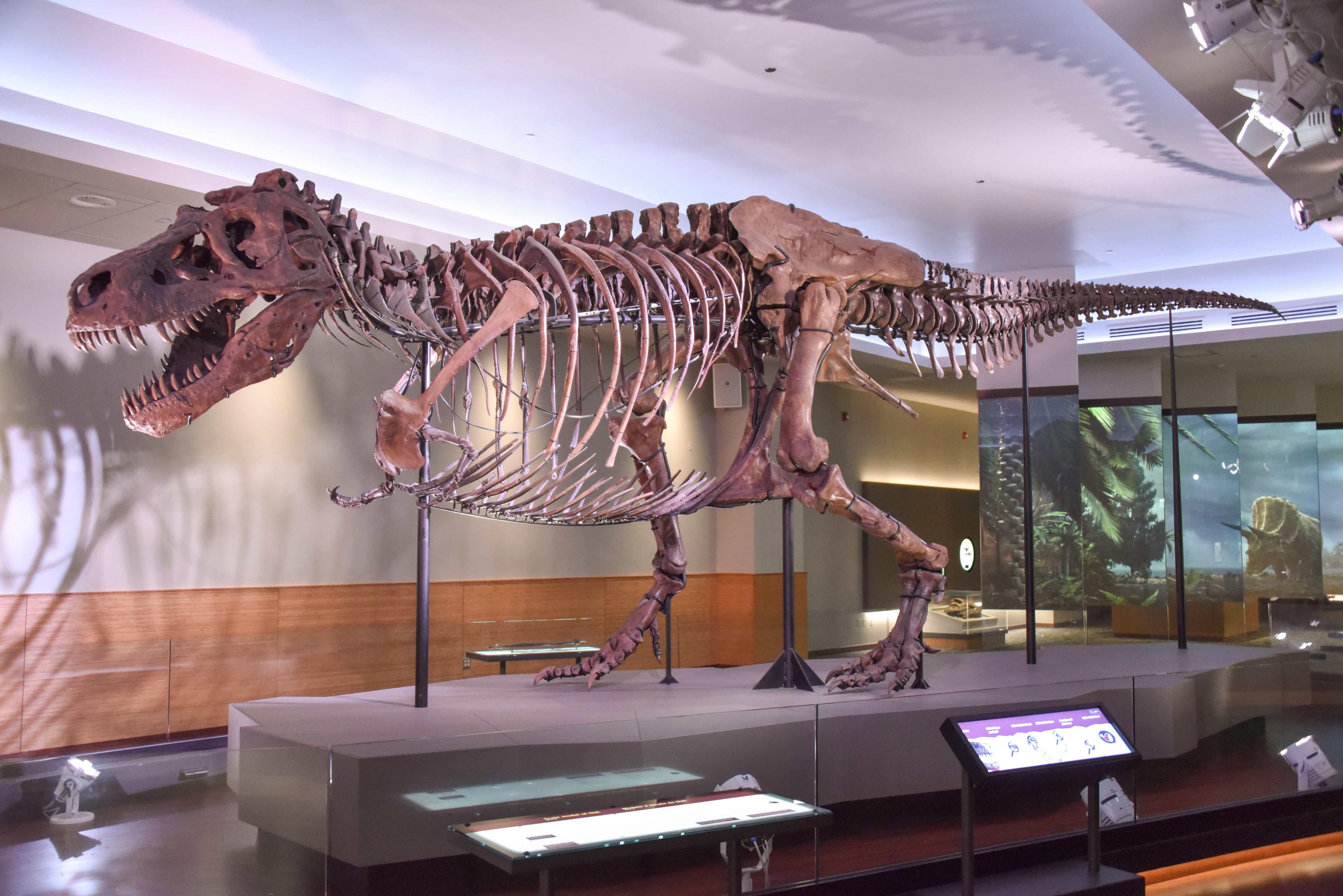
Sue -- Tyrannosaurus rex
$8.36 million
Sotheby's, New York · 1997
The sale that put dinosaur fossils on the map as major auction assets. Bought by Chicago's Field Museum with backing from McDonald's and Disney; still the most complete T. rex skeleton ever found, at roughly 90% by bone mass.
Sue (FMNH PR 2081) on permanent display, Field Museum -- via Wikimedia Commons
Source: Wikipedia →Sue is the only entry with a photo so far, because she's the only one of the five on long-term public display with a verifiable, openly-licensed photo of the actual specimen. Gus, Apex, Stan, and Big John stay image-free rather than substitute a different specimen's photo -- we'd rather ship accurate and image-free than misleading.
Heading out to collect your own instead? See our field gear and expedition guide.